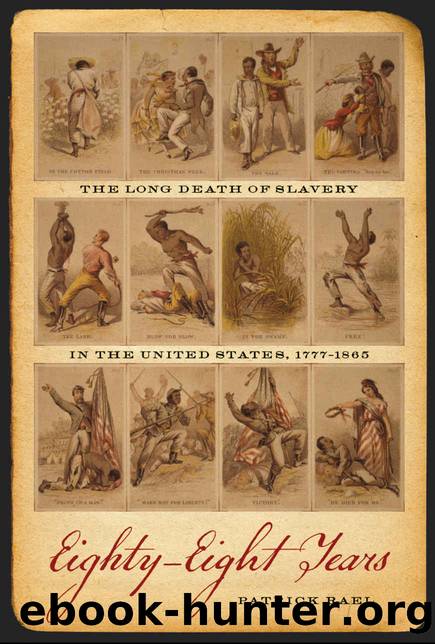
Eighty-Eight Years: The Long Death of Slavery in the United States, 1777â1865 (Race in the Atlantic World, 1700-1900) by Patrick Rael
Author:Patrick Rael [Rael, Patrick]
Language: eng
Format: azw3
Publisher: University of Georgia Press
Published: 2015-08-14T16:00:00+00:00
CHAPTER 6
Ere the Storm Come Forth
Antislavery Militance and the Collapse of Party Politics
YOURS FOR THE SLAVE
Militant Antislavery Activism before 1850
The transformations that struck American politics in the decades before the Civil War might appear at first glance to have been unrelated to the actions of the enslaved themselves. Questions of slaveryâs expansion, or the sectional balance of power in Congress, seemed to have little to do with those who toiled on southern plantations. And no major insurrection had imperiled American slaveholders since Nat Turnerâs rebellion struck during the first years of the radical abolition movement. And yet the reformulation of American politics soon led to a national crisis that created secessionâthe event that led to the war that led to emancipation.
Contrast African Americansâ apparent insignificance in this process with pre-emancipation sites elsewhere in the New World, where slave resistance had played a complex but decisive role in bringing about the end of slavery. Individual acts of resistance had always registered a constant flow of evidence that the enslaved did not find slavery the uplifting and civilizing influence its advocates depicted. Collective violence had made the point all the more clear. Once ideological developments made it possible for metropolitan publics and governors to conceive that slavery could end, the enslavedâs appropriation of revolutionary idioms often made them their own best arguments for freedom. Still, it was easy for free whites in the metropole to consider slave violence evidence of the innately brutish nature of Africans. The work of imparting the meaning of slave resistance to the public fell to antislavery activists. They acted as proxies for the enslaved, amplifying their will and translating their behavior into terms intelligible to the publics and elites who drove politics, and ultimately abolished slavery.
The importance of this combination of forces throughout the Atlantic cannot be understated. Revolt in the periphery melded with antislavery sentiment in the metropole to create a complex dialectic that ledâhaltingly, to be sureâto mass emancipation. Just as slave insurrections in the early nineteenth-century Caribbean had incorporated understandings of metropolitan events, so too metropolitan publics had played vital roles by giving meaning to collective slave resistance. Slave revolt alone was unlikely ever to produce a policy of abolition; in the short term, insurrections usually inspired fierce campaigns of repression. Conversely, abolitionism could hardly exist without evidence that the enslaved themselves preferred liberty. Instead, the two worked together. Resistance and rebellion provided abolitionists critical evidence in arguing that slavery should be abolished. Slave action, when filtered through the values and rhetoric of sympathetic allies in the metropole, could take on emancipatory potential. In abolitionist hands, slave behavior became an argument for the humanity of the enslaved and their inviolable right to self-ownershipâliberty. With this aid, it became possible for those in the metropole to understand slave resistance not as evidence of Africansâ innately savage natures, but as the slavesâ own demand for the very freedom so highly prized by whites across the modern Atlantic. By translating slavesâ acts of resistance into the idioms
Download
This site does not store any files on its server. We only index and link to content provided by other sites. Please contact the content providers to delete copyright contents if any and email us, we'll remove relevant links or contents immediately.
| Anthropology | Archaeology |
| Philosophy | Politics & Government |
| Social Sciences | Sociology |
| Women's Studies |
The Secret History by Donna Tartt(19486)
The Social Justice Warrior Handbook by Lisa De Pasquale(12302)
Thirteen Reasons Why by Jay Asher(9136)
This Is How You Lose Her by Junot Diaz(7078)
Weapons of Math Destruction by Cathy O'Neil(6489)
Zero to One by Peter Thiel(5957)
Beartown by Fredrik Backman(5954)
The Myth of the Strong Leader by Archie Brown(5633)
The Fire Next Time by James Baldwin(5599)
How Democracies Die by Steven Levitsky & Daniel Ziblatt(5340)
Promise Me, Dad by Joe Biden(5240)
Stone's Rules by Roger Stone(5198)
A Higher Loyalty: Truth, Lies, and Leadership by James Comey(5092)
100 Deadly Skills by Clint Emerson(5036)
Rise and Kill First by Ronen Bergman(4914)
Secrecy World by Jake Bernstein(4900)
The David Icke Guide to the Global Conspiracy (and how to end it) by David Icke(4858)
The Doomsday Machine by Daniel Ellsberg(4635)
The Farm by Tom Rob Smith(4614)
